

Can You Grow Tomatoes With Basil?
Are you thinking of growing basil alongside your tomatoes this season? Not all plants make perfect companions in the garden. In this article, gardening expert Melissa Strauss examines if tomatoes and basil are good or bad companions in the garden.


Contents
Tomatoes and basil go together like peanut butter and jelly. There are so many wonderful dishes that pair these two ingredients; Caprese salad, for example, is one of my favorites. But does that mean that these two plants make good companions in the garden?
Just because two plants function well together in the culinary world doesn’t necessarily mean they make perfect garden companion plants.
If you’re already growing these two plants, it would be just as easy to grow them together in the same space. Let’s discuss whether tomatoes and basil make good companion plants. And if so, how do they complement one another in the garden?
The Quick Answer
Yes. Basil makes a great companion plant for tomatoes both in the kitchen, as well as the garden. These two plants create a mutually beneficial environment in the garden where they each support the needs of the other plant. Tomatoes and basil are great together in the kitchen and in the garden.
The Detailed Answer

To understand the symbiotic nature of these two plants in the kitchen, all you need is a sense of smell. The aroma of the fruit of a tomato plant mingled with freshly chopped basil leaves is one not easily forgotten.
Their pairing in the garden is not entirely different. To understand how these two plants work together, we need to discuss companion planting, what these plants offer each other, and whether there are any drawbacks to this pairing.
Companion Planting

Interplanting, or companion planting, is a practice whereby farmers plant two or more crops together in the same space.
The objective of companion planting is to find plants that complement each other in some way that is beneficial to one or all plants involved. It is also important that none of the companions detract from the other. For a better understanding of how companion planting works, take a quick look at the video below.
To determine what the relationship will be between the plants in question, we look at each plant’s needs and growth habits. If these things work together to the benefit of both plants, they make good companions; if not, they don’t. There are several ways that companion planting can be beneficial.
| Pest Control | Certain plants are repellent to pests. Planting these with plants that need protection is a great, natural way to deter pests. |
| Support | Certain plants can be used as a support for other, climbing plants. For example, corn plants can act as a trellis for peaas or beans. |
| Soil Quality | Certain plants, like legumes, can actually add nitrogen to the soil, making it a better place for other plants to grow and cutting back on fertilizer needs. |
| Shelter | Taller plants can protect more vulnerable plants from wind or sun. Plants with large leaves can help protect the roots of other plants, as well as maintaining moisture in the soil. |
Not all plants make good companions, though. Like a bad roommate who eats all your snacks and never restocks the pantry, some plants take more than they give. This makes them bad companions.
Plants that are very heavy feeders should not be planted together. Neither should plants that attract the same type of pests or carry the same diseases.
Basil as a Companion

Basil makes a great companion in many ways. It is capable of repelling pests, which tomatoes are frequently the victims of.
Basil can deter whiteflies, aphids, and thrips. As if those were not enough, basil also may repel mosquitoes and flies, making your time in the garden much more pleasant.
Basil is not a heavy feeder, so it doesn’t deplete the soil of nutrients that tomatoes need to produce flavorful fruit.
Some believe that basil may even have a positive influence on the flavor of tomatoes. Growing basil near your tomatoes is often claimed to improve both the flavor and the yield of your vegetable plants, making basil sound like an incredible partner!
However, it should be noted that most horticultural resources state that there is no scientific evidence that basil improves the taste of tomatoes. They certainly taste great together, but on whether basil is a flavor enhancer, the jury is still out.
Where basil’s greatest strength may lie is as an indicator of potential diseases. Basil often acts as a warning flag, as its tender leaves tend to develop powdery mildew, downy mildew, or other diseases before other plants do. Tomatoes are still prone to powdery mildew, but Basil can act as the first alarm when you start seeing it appear.
This can inform you that your tomatoes are at risk from a fungal attacker and help you to prevent it before disease sets in.
What Tomatoes Offer Basil

Tomatoes aren’t the only ones to benefit from this companion arrangement; basil gets to reap some benefits as well. Regardless of the type of tomato you grow, most tomato plants can grow quite large with lots of leaves that help to protect basil from the intense afternoon sun.
These leaves also help shade the ground, enabling the soil to retain the moisture that basil thrives in. This is a strong benefit to basil, which really performs best when it has consistent moisture.
Adding a nice layer of mulch around the base of the tomatoes and the basil will reinforce the effects of the tomatoes’ shade, helping keep both plants fully hydrated.
This mutually beneficial pairing has no known downfalls. Both the tomatoes and the basil plants should benefit from the companionship of the other, creating bigger, tastier, healthier plants across the board. You might say that these two are both garden and culinary soulmates.
How to Plant Them as Companions
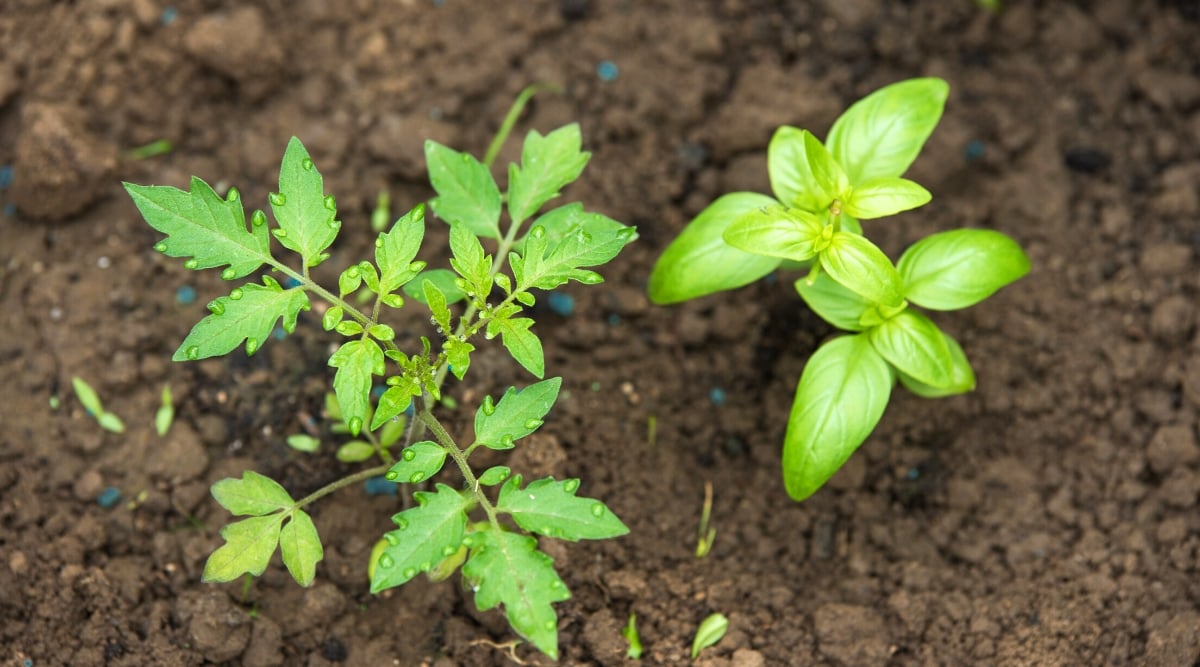
Tomatoes and basil both enjoy the same planting conditions. They like plenty of sun and well-drained soil. They will share the nutrients in the soil well. Basil tends to prefer more nitrogen, whereas tomatoes will want more phosphorus and potassium for flowering and fruiting. This means that a balanced fertilizer feeds both plants perfectly.
While you can definitely plant basil seedlings around your tomato plants, basil can also be directly sown into the ground at the same time that you plant your tomato starts.
Tomatoes don’t go into the ground until the soil is at least 60°F. Directly sown basil will be perfectly happy with this temperature as well, and direct sowing is less labor intensive.
Basil germinates quickly and can be ready to harvest in as little as a month, so it doesn’t take long for your tomatoes to have a friend that plays well with them.
Some pests tend to avoid basil; among these are thrips, whiteflies, and aphids. A few sources also say that it may repel tomato hornworms. While colloquially it’s believed that it’s the aroma of the basil that provides this pest-repelling effect, it’s the taste; with the exception of the tomato hornworm that chews on leaves, all of these pests are sap-suckers who don’t favor the taste of the basil’s sap.
It may well be that the taste is a repellent to the tomato hornworm as well, but the proximity of basil to the tomatoes won’t prevent the parent moth from flying right over the basil to reach the tomato plants, so it’s still best to keep an eye out for those!
Initially, it is a good idea to sow about 4 or 5 basil seeds around each tomato plant. Space them about one foot from the base of the tomato plant, and once they reach a few inches tall, thin them out so that you have two basil plants for every tomato plant.
If you are growing your tomatoes in containers, you can plant a basil plant directly in the pot. If this feels too crowded, you can also place a container of basil next to your potted tomato plant, and this will have a similar effect.
Tomatoes are heavy feeders, they like to be fertilized about every two weeks with an organic fertilizer once the plant has set fruit. The basil won’t mind the added nitrogen if you use a balanced fertilizer, so this works out well.
Basil is a great pollinator plant if you allow it to flower. Some species of bumblebees absolutely adore any kind of blooming basil, so this encourages pollination of your tomato plants as well. Just keep in mind that basil self-seeds heavily, so where you had one plant last year, you may have several more in its place next year.
Our Recommendation

We give tomatoes and basil a huge thumbs up, both in the kitchen and in the garden. The benefits of this companionship will have your garden booming with wonderful smells and beautifully ripe tomatoes.
While you’re at it, why not throw some onions in the mix as well? Onions make this a magical trio of culinary delight. It is happy to grow in whatever small space is left over and also does a great job of deterring insects. Some onions will be ready to harvest partway through the tomato season, although you can do cut-and-come-again harvesting of the onion greens, too.
Final Thoughts
Basil makes an excellent companion to tomatoes. These two plants share the space well together, don’t compete for nutrients, and basil can be a great identifier of potential disease issues so you can protect your longer-lasting tomato plants. With no downfalls to speak of, this is a perfect match!


