

Raising Chickens for Eggs: The Ultimate Beginner’s Guide
Raising chickens has become a popular way to offset grocery costs and have a supply of the freshest, cleanest eggs possible. Join chicken mama Melissa Strauss for the lowdown on getting your egg layers up and running.


Contents
Like many folks, raising chickens for eggs always sounded like a good idea to me. Finding the time and motivation presented a hurdle that, for many years, kept that idea on the back burner. That is, until COVID-19 sent us all home to learn how much work teachers actually do and try to figure out how to utilize the time we now have to navigate a new normal that was anything but.
I found myself at home 24/7 with two kids and another on the way, and little direction or knowledge about the future. Suddenly, it seemed like a great idea to bring home some fuzzy little chicks to keep those kids busy and maybe learn a new life skill that could become important one day.
Little did I know that five years down the road, those chickens would turn out to be such a gold mine. I also had no idea how quickly eight chickens can turn into 18 chickens, a rooster, three ducks, and three beehives (we’ll get to chicken math in a minute). These days, I have more than enough eggs to share with neighbors and loved ones.
What I didn’t have was a true idea of what needed to happen to get this chicken operation up and running. Over the past five years, I’ve learned a few things and gotten some interesting surprises along the way. I’d love to give you a basic overview of how to get started with the useful hobby of raising chickens for eggs.
Taking the Plunge
If you’re like me, this section may come a little too late. By that, I mean that if you tend to be impulsive about starting new things, there’s a fairly good chance you already have a box full of chicks in your living room. If not, congratulations! You are going to save yourself some time and probably a fair amount of money and stress.
Do the Math

There are different schools of thought on deciding how many chicks to start out with. The most sensible way to make this decision is to determine how many eggs your household can consume if there were an unlimited supply. For my family of five, it works out to be about two dozen per week.
When you make this determination, the breed you choose will factor in. Some hens lay an egg every other day. Others lay every day. Very few breeds lay less often than that, at least in their first couple of years. As your hens age, their production will slow down, but chicken math typically takes care of that.
In any case, if you buy a breed that lays daily, and your family eats one dozen per week, you could get away with two hens to start. If you choose a breed that lays only every other day, you’ll need closer to four.
Now, Do the Chicken Math
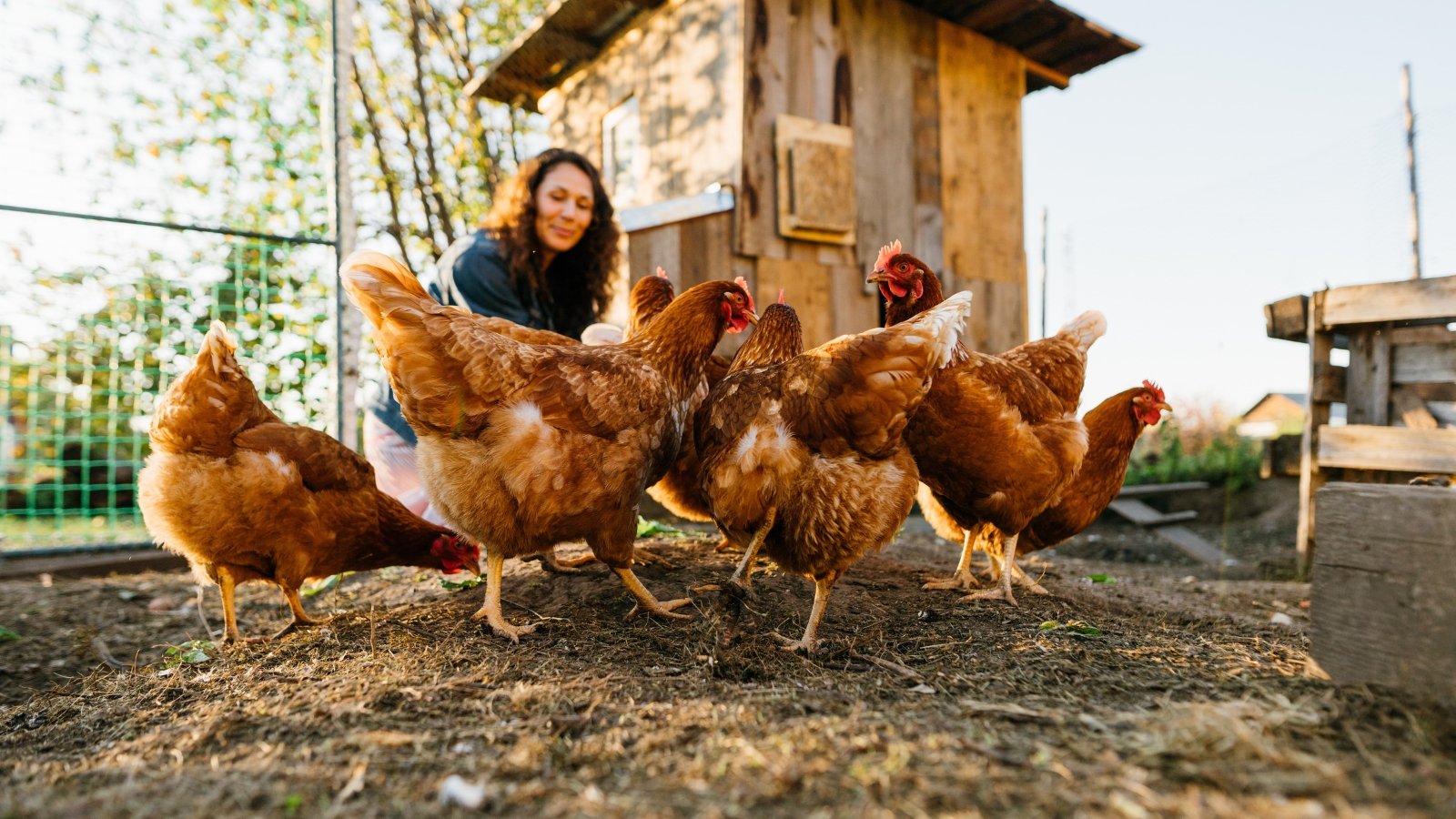
If you’ve spent any time on the chicken side of Instagram, you’ve probably heard of chicken math. Another common agreement is that chickens are a gateway drug. Both of these concepts are one hundred percent real and affect quite a large number of chicken tenders.
If you have excellent self-control, these two things may not apply to you. In this case, stick with your nice, neat number and set yourself to care for your four, eight, or however many birds you’ve landed on.
My advice is to take it from seasoned poultry parents, accept that chicken math is real, and adjust your plans accordingly. In other words, plan to accommodate a few more birds than you need to meet your needs. After all, it’s always better to be over-prepared than wish you had planned ahead.
Preparing Your Space
You don’t have to have acres of land to raise chickens for eggs, but no matter your location, you will need to decide how much of your space you are willing to devote to this endeavor. Where will you allow them to go, and what parts of the yard are off-limits?
How Much Space Will You Give Them?

I know folks who raise birds in urban settings, rural ones, and everywhere in between. Personally, I’m on just over a half-acre, and my girls have a partially enclosed run that takes up about 3,000 sq. ft. of my backyard. Mind you, they don’t all stay in that space; some of them can jump the fence. But it’s typically the friendlier ones, so we deal with their mess.
If you live in an urban setting, naturally, you’ll need to contain your birds in a more limited space. Don’t worry too much about this. Your chickens will be fine as long as you give them plenty of enrichment. Chickens love to swing and have material to dig around in.
Free Range or Not

Another question to consider is free-ranging. When it comes to buying eggs commercially, this term means something different from what it typically means to those who own their own birds.
Commercially, free-range means that they have access to the outdoors. However, the amount of time and the outdoor conditions are not clearly delineated. But for those who want their eggs to come from animals with a decent quality of life, this is significantly better than caged eggs.
Free-range for hobby farms typically means something similar, but a bit healthier. If you intend to allow your chickens to have access to an outdoor foraging area, you’re planning to have a free-range situation. Commercially raised eggs labeled as ‘pasture-raised’ are closer to what your hens will produce.
So, what is the difference, and does it really matter? Well, the answer is yes and no. In terms of nutrition, free-range eggs are superior. They contain more vitamins, omega-3 fatty acids, and antioxidants, which affect the color of the yolk. They also contain less saturated fat and cholesterol.
That sounds like a resounding yes, but there is another factor that can influence the nutrient composition of your eggs. If you don’t have space to let your birds roam free, you can supplement their diet to increase the concentration of these nutrients.
I advocate free-ranging if possible. Even if it’s only a small space, it typically results in happier chickens. They will find more to do, and your coop will be a more peaceful place.
Another concern about free-ranging is safety. You have to remember to lock them up in the evening, and you’ll need some other safeguards in place. An automatic door on the coop is an incredible invention that does the first job for you. There are also methods of monitoring your run for predators.
What Areas Should Be Off-Limits

If you’re a gardener or have areas of the yard where you prefer not to have chickens present, you’ll want to make these inaccessible. Some gardeners don’t mind sharing their plants with their chickens. I’m not one of them, but if you are, share away!
Chickens do less eating of garden plants, and more digging and damaging of roots. We made the mistake of giving our entire flock access to our yard when we first got them. We had to lay fresh sod a year later because they trashed the grass. A handful of hens is not likely to cause that much trouble, but don’t forget about chicken math.
Another issue I’ve come up against is mulch. Mulch is important to gardeners, and it’s also really fun to dig in. Bugs hide in there, and chickens love to eat bugs. They absolutely will throw your fresh mulch in every direction, looking for snacks. If you can live with that, you have nothing to worry about.
You also want to keep them out of harm’s way. If you have a dog and you’re not sure what kind of prey drive they have, you could end up with dead hens. Likewise, keeping them away from the street is necessary, as you don’t want them to get hit by a car.
Predator Proofing

Finally, you must consider the presence of predators. Neighborhood cats are unlikely to be a problem for fully grown hens. Our kitty enjoys their company and doesn’t try to get too close. Most cats take a similar approach, though they may enjoy stalking and flushing out the group from time to time.
The predators to worry most about in rural areas are large birds, skunks, and raccoons. If your hens are small enough for a hawk to carry off, they will try. Raccoons and skunks are terrible when they get into the coop. They are highly resourceful and will do whatever they can to figure out the best way in. And they will eat your chickens. They often kill more than one in a night.
Foxes can be a problem in a more suburban location. They eat birds, and they are larger and stronger than raccoons, so they can carry off more than one at a time. They’re also quite fast, and once they find a hunting spot, they are likely to return. We have lost several hens over the years to foxes.
I’ve also encountered snakes in the coop, and this is never enjoyable because they will come looking during the day. Snakes are less of a threat to adults and more troublesome to chicks and eggs. They like to eat both of these, and they will return if they have the opportunity.
Nighttime is the most vulnerable time for chickens. It’s important to create a safe and predator-proof coop situation. Chicken wire does not keep predators out; it just keeps chickens out. Hardware cloth is far more effective in keeping out predators. If your coop and run don’t have a solid floor, make sure you run hardware cloth down a few inches below the soil, or foxes can dig right underneath.
Select a Coop

There are several options for a coop set-up, and while they all look similar, they are not all equal. Depending on the number of birds you keep, you may need more than one coop or a larger one. If you build your own, you have some control over the size, but it’s considerably more work and time.
Each bird needs about three to four square feet inside the coop to sleep comfortably. Larger breeds need more like six. Each one should have about eight inches of roosting space. An attached run is a good idea, particularly for those with smaller spaces, because it gives your birds some protected outdoor space, which they will appreciate.
Smart coops are a great solution for those getting started or those who want to upgrade their current situation. If you’ve had predator issues, these can make a huge difference. While there are more economical solutions out there, The Smart Coop+ by Coop is a truly superior set-up.
The Smart Coop+ has space for up to six hens to sleep comfortably. It’s weatherproof and completely outfitted to meet your needs without any further considerations. Its automatic door opens in the morning and closes in the evening to keep your girls safe.
In terms of convenience, The Smart Coop+ has feed and water canisters that are detachable and easy to refill. It’s easy to clean with custom-fit litter trays that you can swap out in less than a minute. It’s also completely predator-proof and has smart cameras with AI-powered alerts to notify you when and if predators come around.
The Smart Coop+ has plenty of bells and whistles and lots of add-on options for the chicken lover who wants the most technologically advanced and safest solution. It’s user-friendly, easy to assemble, and even comes with a voucher for chicks from My Pet Chicken! It’s an all-around superior product and definitely tops our list for the most comprehensive and user-friendly setup.
Choose Your Breeds
Now that you’re all set up and ready to host some fluffy babies, it’s time to consider which breeds will suit your needs best. Since we are talking about raising chickens specifically for eggs, we can skip over meat birds. Raising them is a completely different process.
Layers vs. Dual Purpose

When it comes to egg production hens, there are two basic categories to pay attention to. Some hens, through breeding or naturally, have smaller bodies compared to the size of their eggs. They weigh less, so they require less feed, and they usually lay more frequently.
These birds are your layers, and they are the most economical and productive choice if all you’re concerned with is maximum egg production. Many of these breeds are good foragers and do well in a free-range situation. When it comes to converting feed to eggs, these are the most efficient.
The second type of chicken to consider is dual-purpose birds. If at any point you intend to eat your chickens, this is the way to go. They are larger and heavier, and they tend to be decent layers but not as efficient as the first type. Dual-purpose birds will eat more, and they will lay slightly less. They also tend to be friendlier, in my experience, but more on that in a minute.
Egg Colors

Egg color is not something that matters to everyone who is raising chickens, so if that’s you, you can skip this section. Aesthetics are important to me, and so I selected my girls based not only on breed but on egg color as well. I can’t help it. I love a colorful egg basket.
Brown and white are the two colors we are used to seeing in the grocery store. However, there are also breeds that lay blue, green, olive, and pink eggs. There is a whole rainbow of options, and it’s been my objective to collect as many types as possible.
If you want a hen that lays a lot of pretty light blue or green eggs, Easter Eggers (EEs) are perfect. Friendly and docile, they have larger bodies, but they are great layers, though their eggs are medium-sized. Other blue layers include Ameraucanas, Legbars, Whiting True Blues, and a few other rare breeds.
For dark chocolate-colored eggs, Marans are the way to go. This French breed has feathered feet and lays large, deep brown eggs. The darkest layers are Black Copper Marans. They are relatively friendly and easy-going. Also in the dark brown category are Welsummers and Barnevelders. Many of these lay speckled eggs, which make them appear darker.
Our oldest and most inquisitive hen, Sophie, is a Cuckoo Marans. She loves to join us when we have dinner outdoors, and she will also invite herself in if we leave the back door open. Her eggs have dark brown speckles all over them.
A combination of these two, where the mother is a blue layer, and the father is of a dark brown laying breed, will result in something called an Olive Egger (OE). These girls lay gorgeous eggs in varying shades of deep green, some with speckles.
Temperament

If you’re not concerned with how friendly your birds are, layers are probably your best bet. However, in my experience, they can be a little wilder, less docile.
That said, we have an ISA Brown who refuses to get in the coop at night in favor of sleeping outside my bedroom window. This is where she feels safest, and she follows my husband to let the other birds out every morning. ISAs are great layers of extra-large, dark brown eggs. They have a short molting period, so they lay nearly year-round.
Ameraucanas, as I mentioned, are docile and friendly. If you have kids, these are a great choice because they take well to handling and petting. Orpingtons and Marans also tend to be quite friendly. Other easy-going breeds include Australorps, Brahmas, Wyandottes, Cochins, and Barred Rocks.
I don’t know if this is just a fluke or if there is something to it, but I find white egg layers to be the most flighty and least friendly. Leghorns are fantastic foragers with small bodies, and they lay large, white eggs. They’re not that friendly, though. I also have an Andalusian that lays white eggs, and is not friendly.
Sadly, it is also my experience that the larger, friendlier, more docile breeds are more vulnerable to predators. We recently lost a beautiful Brahma named Elsa. Brahmas are large, sweet, and smart, but they are not that fast, and it’s more difficult for them to get out of the way of land-dwelling predators.
Variety

Some chicken owners prefer to raise multiple egg-laying birds of the same breed. If you like uniformity in your eggs, this is the way to go. However, if you ever intend to introduce another breed, you could run into problems.
Chickens see a wide range of colors, and they remember faces, both human and other birds. They also discriminate based on breed. You’ve heard the saying, ‘Birds of a feather flock together.’ That saying applies here quite well.
Chickens also have a distinct pecking order. There is a top and a bottom, and everyone else falls in a specific position in between. When you introduce a bird that looks different from all the rest, she is all but certain to get picked on by everyone else.
I determined that, in addition to egg color variety, I wanted to have as peaceful a flock as possible. For that reason, I rarely purchase more than two of one breed, and I always introduce at least two at a time. Never add just one bird to an established flock. Once again, she will be at the bottom of the order, and she will be lonely. The more diverse your flock, the less likely you are to see fighting or ganging up.
Do You Need a Rooster?

We all know of that one influencer who has a cuddly rooster that likes to sit on the couch, watch Netflix, and eat popcorn with their five-year-old. There’s a reason their reels get so many clicks: it’s because those roosters are one in 1 million.
Here are my two cents on roosters. A rooster can provide some security for your flock, so if predators are a significant threat, it’s a good thing to have. They also make it possible to hatch your own eggs, which is a fun thing to do at least once.
Roosters are also some of the most unpleasant animals I’ve ever encountered, and I’m a beekeeper. They are particularly unpleasant during their first spring after maturing when their testosterone levels are out of control. They will become protective and aggressive during this time, and if they don’t see you as dominant, they may turn on you.
We had a great rooster named Bruce, a large, blue-laced Wyandotte. He was gorgeous. He was calm. Furthermore, he was a great protector and loved to follow me around the garden chatting. He was perfect until he tried to flog my two-year-old. Then, it was off with his head.
Our current rooster ranks much lower on the likability scale. He’s a beautiful little terror, and his name is Napoleon if that tells you anything. My husband is the only person he doesn’t attack. I never turn my back on him. However, he is a pretty good protector, and I’ve seen him lose spurs fighting off predators.
So, if you’re concerned about predators or want to hatch chicks, a rooster is a good thing to have. Otherwise, I don’t recommend it. They don’t make good pets and you can rarely trust them around kids. You should also be prepared to take care of things if you need to go to the chopping block because it attacks your toddler.
Raising Chicks
Caring for babies is the most labor-intensive part of having chickens. Plan to have them indoors or in another warm, protected place for about 12 weeks. Expect them to get bigger than you think. They are stinky, messy, and noisy. They are also the cutest little fluff balls you’re ever going to lay eyes on.
Hatching vs. Live

I recommend buying your first round of chicks live and from a reliable hatchery. Buying from unreliable sources can be a crapshoot, as not everyone who thinks that they know how to determine the sex of a day-old chick actually does it accurately. After years of raising them, it gets easier to tell, but there are few surefire methods to tell if you’ve got a pullet or a roo until they crow or lay an egg.
Most hatcheries will vaccinate your chicks for Marek’s disease unless you specify otherwise. They will have a minimum order number, which changes with the time of year. In the spring, expect to have a higher quantity requirement because of cooler outdoor temperatures.
Hatching eggs is great fun. It’s an interesting process, and it’s fun to hatch babies of birds you love. Just prepare yourself for roosters. Expect that half of the eggs you hatch will be males, and make a plan for them.
Brooder Tips

You can make a brooder or purchase one. The size should depend not only on how many babies you’re putting in there but how big they will be in a couple of months. There is a wide range of brooder solutions depending on your budget. Remember that those babies will grow quickly and learn to fly out of an open brooder.
You’ll also need a heating lamp or plate. A heating plate is the safest option, as lights can occasionally cause fires. They also provide darkness and better mimic a mother hen.
You will want to use some type of bedding, like pine shavings or sand. I’ve also used puppy pads in the bottom, but the cleanup can be messy. It’s easier to use biodegradable or other natural litter that you can dump in the compost pile.
Feeding and Treating

Your new chicks will need a different type of feed from adult birds. They need more protein. Adult layer feed contains between 15% and 18% protein. It also contains extra calcium for harder shells. Always provide them with clean, fresh water, especially on hot days.
In their early weeks, babies need a minimum of 18% and preferably 20% protein. Some feeds go as high as 22%; these are all appropriate levels. You can purchase your starter feed medicated or unmedicated. The medicated feed combats a parasitic infection called coccidiosis.
For birds living in a limited outdoor space, grit is an important supplement to their diet. Grit aids digestion for better nutrient absorption. Free-range chickens can typically obtain grit from their environment, but it won’t hurt to provide some additional grit even for free-rangers.
Ground oyster shells are another supplement you’ll probably want to provide. This, again, may not be vital for free-rangers, but it won’t hurt either. For confined birds, oyster shells provide essential calcium to make their bones and eggshells harder.
If you’re giving your birds layer feed, it already contains calcium, so supplementing is optional. You can also give them back their eggshells as a calcium supplement.
Finally, chickens love treats. Most owners save food scraps for their birds, and for the most part, this is a great idea. They can and will eat most fruits and vegetables, but will also eat most protein sources that you give them. Hens will typically avoid things that are unsafe to eat, but there are some things you shouldn’t give them.
Your birds should not consume raw beans, avocado seeds and skin, citrus skin, green potatoes, apple seeds, onions, chocolate, coffee, and the leaves of nightshade plants. Fruits and veggies that are slightly overripe are just fine, but never give them anything moldy.
Scratch feed is great for enriching your chickens’ diet. It consists of seeds, corn, and sometimes insects. Soldier worms and meal worms are great additions, and chickens adore strawberry tops.
Key Takeaways
Raising chickens is a lot of fun. They are pleasant company in the garden, and when it comes to egg quality, they are top-notch producers. Protect your birds from predators, feed them lots of nutrient-rich foods, and most of all, enjoy how beautiful and fascinating they are to watch.


