How Fast Do Mango Trees Grow?
Are you wondering how long you'll have to wait for your mango tree to produce sweet and delicious fruit? If you want to know how long it will take for your tree to grow, we have the info you're looking for. Join Florida gardener Melissa Strauss to talk about how fast mango trees grow.


Contents
Sweet, juicy, and full of fiber and nutrients, people love mangoes. I love to put them in a green smoothie to sweeten things up. Even though they can be a challenge to peel, these delicious fruits are worth the time and effort.
The trees are attractive and make a nice addition to the landscape. They are also relatively fast growers, so they don’t take long to start looking like established residents of the garden. With their dense foliage and mounded canopy, they make excellent shade trees.
Add to these qualities the fact that mango trees can live 100 years or longer, and you’ve got a wonderful tropical evergreen that will give you tasty fruit for the rest of your life. So, just how fast do mango trees grow? Well, in relation to their lifespan, they grow surprisingly quickly. Let’s talk about it.
Glenn Mango Tree

- Fiberless, sweet fruit
- Compact and container-friendly
- Cold-tolerant and versatile
- Low maintenance
- Attractive foliage
The Short Answer
Given the right conditions, a mango tree should be ready to bear fruit in about five to seven years to bear fruit if you grow it from a seed. If you purchase a grafted sapling, expect to have fruit in as few as two years, but as many as five. The timing depends on the variety of mango and the general care and nutrients.
The Long Answer
How you propagate your mango tree and the conditions in which you plant it determine its growth speed. Mango trees are long-lived, with many living past 100 years old, and some are on record for living as long as 300 years!
Once they reach maturity, mango trees can produce quality fruit for 40 years or longer. Even after they cease producing fruit, mango trees are attractive additions to your garden landscape.
Mango Tree Care

How you care for your mango tree is a main factor in how fast it grows and the length of time it takes to mature. With the right care, it will grow significantly faster from the start. Meeting its specific needs will help establish those roots faster, and the tree will follow soon after.
Light

Mango trees will grow in full sun or partial shade, but you’ll see the most rapid growth in full sun. Planting in full sun will also, ultimately, result in better fruit production. A bit of shade in the afternoon is good in very hot climates, but at least eight hours of sun early in the day is ideal.
Water

These trees develop a tap root that helps to anchor them in place. This is great for regions accustomed to frequent hurricanes because it means that they will hold up better in a storm and withstand more wind. To get that tap root growing, you’ll want to water deeply and frequently in the first few weeks after planting. Every other day is appropriate during this time.
After the first few weeks of frequent watering, reduce the frequency to once per week for the first year. Factor in rainfall, though, as you don’t want to rot the roots with too much water. If you go through a prolonged dry period, you can bump it up to twice weekly as the ground will dry faster when the water table is low.
After the first year, you’ll only need to water during droughts. Once it’s established, once every two weeks is fine.
Soil

Mango trees aren’t picky about soil. They are native to tropical regions, so they are happiest in fertile soil with a fair mixture of sand and organic matter. While this is the optimum soil condition, ultimately, the soil isn’t a main factor as long as it drains well and has a decent nutrient content. It prefers slightly acidic to neutral soil.
Clay soil can be difficult because it’s harder for that tap root to break through. If that root doesn’t go down deep enough, your tree won’t be as stable and will grow more slowly. If you have a lot of clay in your soil, make sure you dig down deep and amend it with plenty of loose material like sand and compost.
Temperature

This is a tropical tree, and it does its best growing in warm weather. It thrives in temperatures of 70°F (21°C) and higher. It’s also fairly cold-tolerant for a tropical. While young foliage and flowers can sustain damage if the temperature dips below 40°F (4°C), a mature tree should be fine as low as 25°F (-4°C). They like humidity, and prefer 50% or higher, ideally.
Fertilizer

I consider mango trees to be heavy feeders in order to grow large and prolific. They need nutrient-rich soil, and they need fertilizer. They specifically need a lot of potassium, magnesium, and chelated iron. Chemical fertilizers are too harsh for this tree, so opt for something organic. A fish-emulsion blend or organic fertilizer with a high potassium content, with side dressings of chelated iron, is perfect. Feed it once in the early spring and then repeat two to three more times between May and October.
Pruning

In the first year or two, you don’t need to prune, just let your tree grow. After that, focus on keeping the crown open so that air can circulate by removing any crossing branches. Horizontal branches bear more fruit, so work on keeping the canopy wide and low to make it easier to harvest.
Grown From Seed

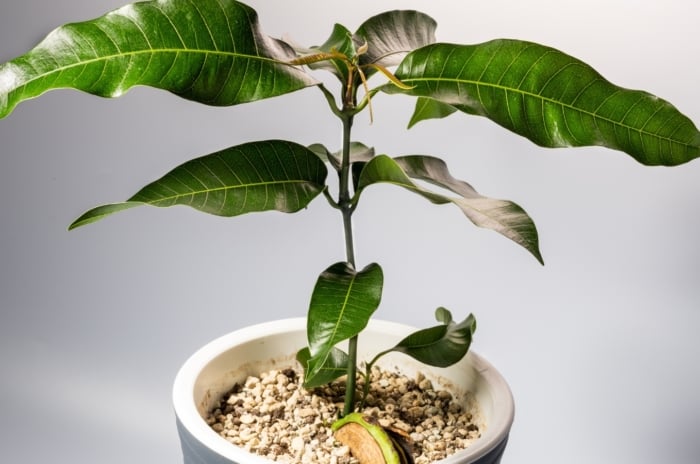
Mango seeds are not difficult to germinate, and if you don’t mind the extra time it takes to mature, a seed-grown tree is a fun experiment. If you get a particularly sweet and delicious mango, you can save the seed and use it for this purpose.
When you grow from seed, a mango tree will mature or reach fruit-bearing age somewhere between five and eight years after planting. That’s quite some time, but as I said, it’s not difficult to do, and you can certainly grow several trees at little to no expense. Mango seeds germinate according to the fruit’s ripeness, so allow it to ripen, and it will germinate faster.
How to Do It:
- Acquire your seed by purchasing or removing one from a fruit yourself. Make sure to remove all the flesh to avoid rotting.
- Allow the seed to dry for a day, and then cut open the husk to expose the seed. The seed should be white; any darkness indicates rot and makes it unviable.
- Wrap the seed in damp paper towels or a tea towel, and place it in an airtight container or ziplock bag.
- Set the bag or container in a warm, well-lit spot like a sunny windowsill.
- Once the seed sprouts and has some green growth, plant it in a nursery pot or other container with moist, well-draining but rich potting mix. Cover the seed with soil, leaving only the green portion exposed.
- For the first week, keep your plant in bright but indirect sunlight. Keep the soil moist, and after a week, move it to a full-sun location.
Grafted Sapling

Grafting is more complicated, so frankly, I suggest letting the professionals handle it unless you’re really determined to accomplish this yourself. A grafted sapling will mature faster, and produce fruit in as few as three years, though it can take up to five. If you want to carry this out yourself, you’ll need another tree or a friend who has one and doesn’t mind you taking a branch, you’ll also need a hearty rootstock.
How to Do It:
- Start with a healthy rootstock that has a substantial stem and a healthy branch with new growth. The stem should be green, as should the branch, and the branch should be slightly thinner than the stem.
- Using a sharp, clean knife, cut the end of your branch into a wedge shape. This exposes more green wood for it to fuse to.
- Use your knife to split the stem of your rootstock in half down to about one inch from the base.
- Gently insert the wedge-shaped end of the branch into the split in the stem so that it makes as much contact as possible.
- Secure the joint with grafting tape and cover it completely with a plastic bag, down to below the graft, and secure it to form a makeshift greenhouse.
- Once your branch shows some new growth, you can be certain that the graft was successful. At this point, you can remove the bag and the tape and allow your young tree to develop.
- Keep the soil moist and give it indirect sun for the first week, followed by full sun thereafter.
Final Thoughts
Whichever way you go about securing your mango tree, it’s certain to be not only a beautiful part of the landscape but a welcome addition to the diets of all who benefit. Enjoy this lovely, long-lived tree with its delectable fruit for many years to come!