20 Haworthia Varieties You Should Grow
There are many Haworthia succulent types, and we're listing our favorites here! Explore the world of Haworthia varieties with us.

Contents
Pointy, textured, translucent… succulents in the Haworthia genus have it all! With over 60 known types of haworthia, this broad genus contains an assortment of traits that are perfect for any home garden. There’s a lot of ground to cover when it comes to Haworthia succulent types, so we’ll touch on some of the most common and intriguing species.
Haworthia succulents are native to South Africa, where they enjoy hot, dry weather. They actively grow in the spring and fall and then go dormant in winter and early summer. True succulents, they are slow-growing and store water in their leaves to help them survive drought. They can thrive in potting soil, direct sun or partial shade, and produce pups from the parent plant. You can also propagate them by leaf cutting.
When taken out of their native habitat of South Africa, gardeners must provide lots of bright light or bright indirect sunlight and be wary of excess soil moisture. If necessary, you can repot them in fresh soil when too much moisture causes rot. They bloom much as aloe flowers do. None are cold hardy, and they cannot sustain themselves even in light frost.
The classification of the Haworthia genus and Haworthia types is messy. Species names and groupings are frequently debated and changed (though they all remain in the Asphodelaceae family). While many Haworthia varieties look very different, lots of them are extremely similar. Here are some interesting varieties to look for.
Haworthia obtusa

This is one of the Haworthia varieties that stands out from the rest (and one of my favorites). H. obtusa is nicknamed “mini aloe” but looks more than anything like a bundle of water balloons. Its chunky leaves are transparent, showing off the water storage inside.
The chlorophyll is located inside the leaves, which is believed to increase the rate of photosynthesis. Many Haworthia species have these features, called leaf windows, but few are as prevalent as mini aloe’s.
This succulent has another accepted scientific name: Haworthia cymbiformis var. obtusa. It’s also often confused with Haworthia cooperi. You can tell the two apart by their leaf margins. Mini aloe is completely smooth, while H. cooperi is lined with “teeth.”
Haworthia cooperi

Just like mini aloe, Haworthia cooperi‘s leaves feature large leaf windows. When placed in a window, the direct sunlight shines right through them, making this a beautifully ornamental plant. The base of each leaf is usually opaque, with some veins lining the windows.
In nature, the solid portions usually grow underground, so only the leaf windows peek out. There are many varieties of Haworthia cooperi that vary in bristle length, color, and leaf shape.
Haworthia cymbiformis

The leaf windows are less prevalent on these haworthia varieties, but still obvious enough that it’s earned the name cathedral window haworthia. The windows are concentrated on the tips, so most of each leaf is cloudy green. The leaves are boat-shaped, pointier, and flatter than those of H. cooperi and H. obtusa. Boat-formed haworthia produces white and pale pink flowers, though infrequently due to their slow-growing nature.
Haworthia cuspidata
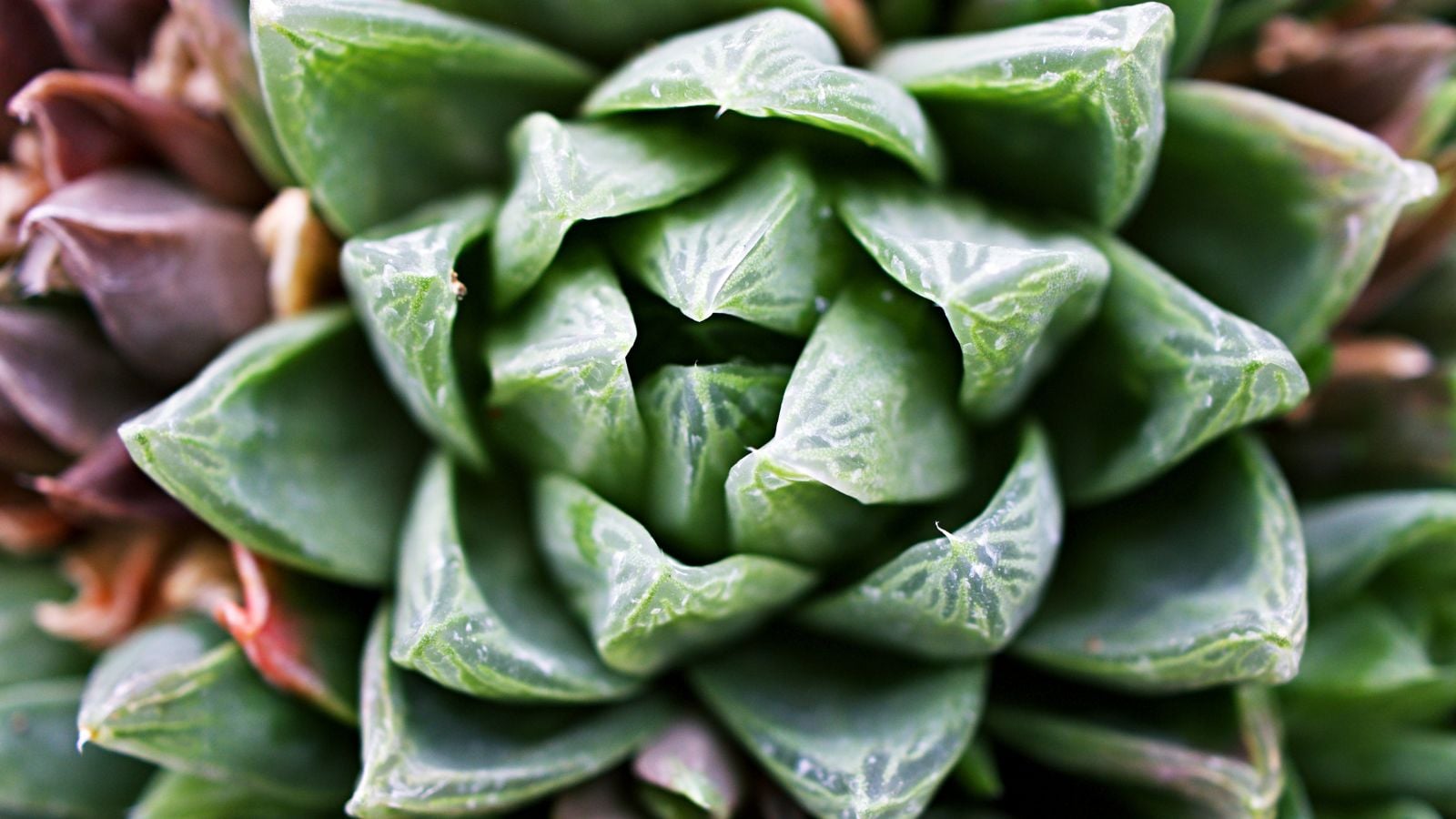
Botanists still debate the legitimacy of this species since many argue that it’s actually a hybrid of Haworthia retusa and H. cymbiformis. Whatever we call it, though, no one can argue with the common name of star window plant. The leaf windows of Haworthia cuspidata contrast sharply with its opaque leaves, showing off a starburst pattern. Its leaves are short and chunky, which, paired with densely leafed rosettes, makes for a cutely condensed succulent!
Haworthia transiens
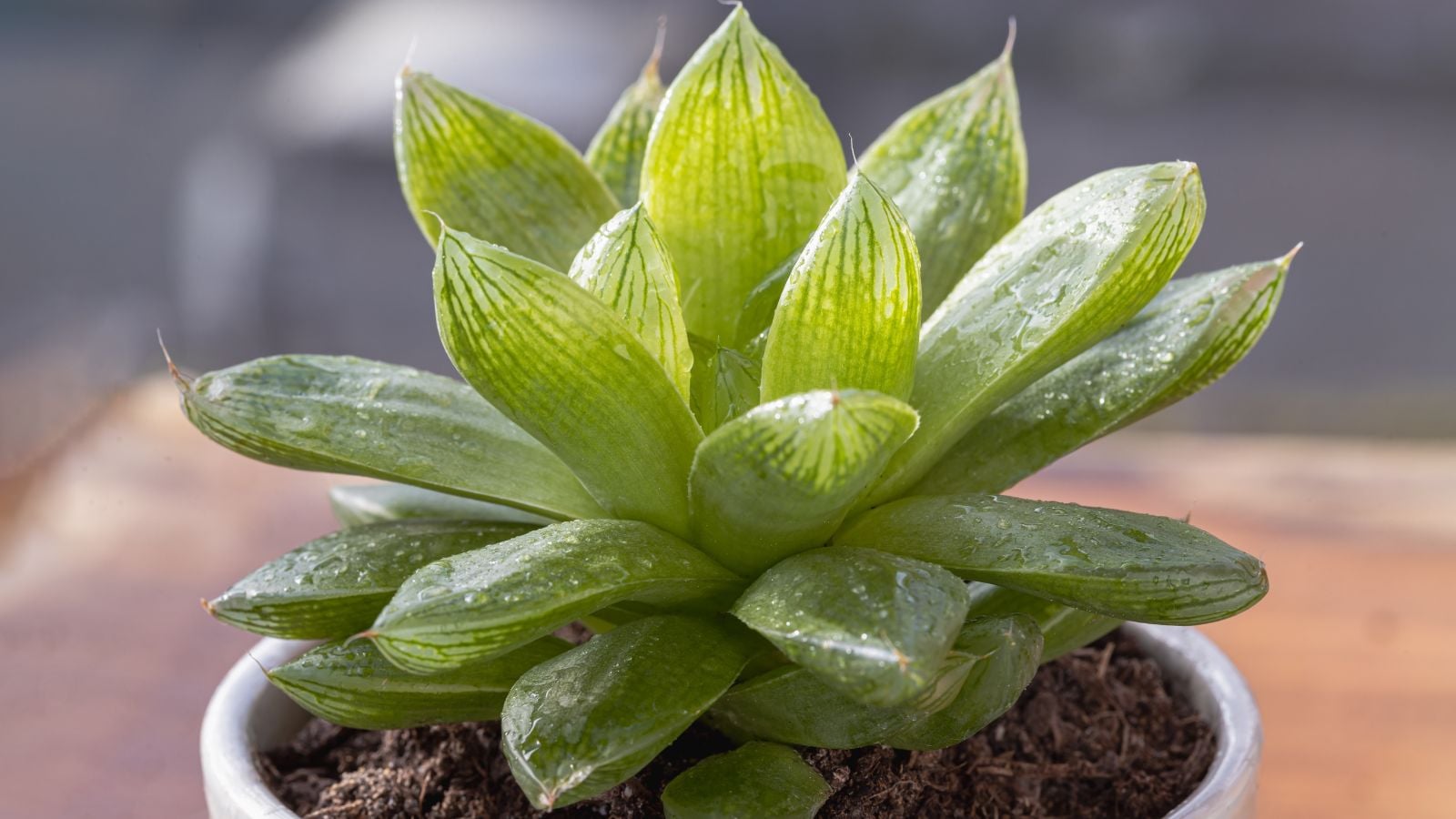
H. transiens is very similar to and sometimes referred to as a cultivar of H. cymbiformus. The most obvious difference we can see is its coloring. This succulent is very light green and sometimes golden yellow. The leaf margins are toothed and topped with a pointy tip.
Haworthia bayeri
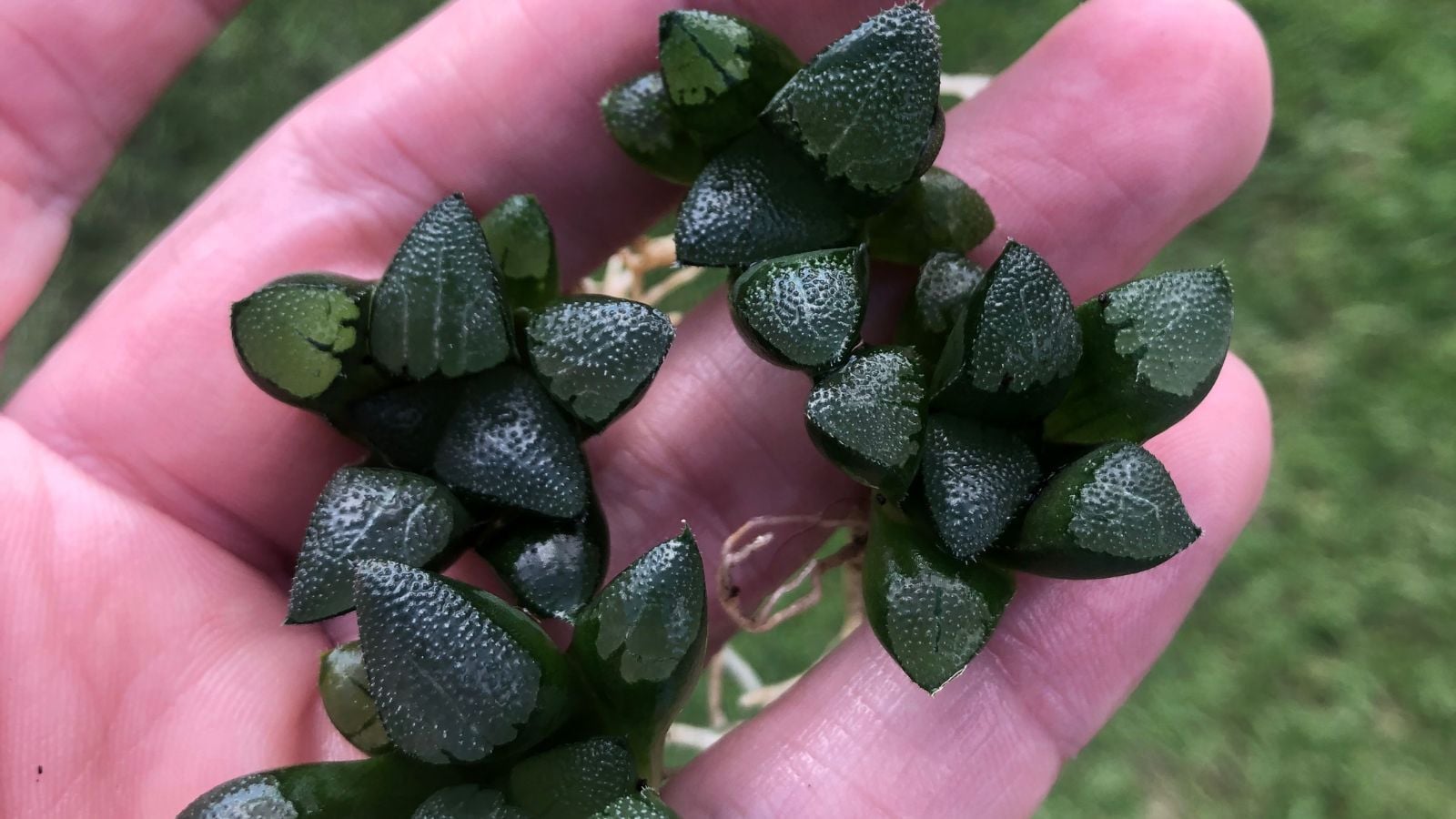
This is one of the more elegant succulents. Instead of the typical light green leaves, it has gorgeously dark green leaves that shimmer where fenestrated. The different leaf shapes are intriguing. The top is shaped like a petal, while the rest is a solid extension of that shape.
Each leaf has light-colored, dainty lines along the top. Unlike most haworthia varieties, H. bayeri rarely spreads through offsets (you’ll have to use leaf cuttings). H. bayeri is similar in appearance to Haworthia springbokvlakensis and Haworthia emelyae.
Haworthia bolusii

Haworthia bolusii is the perfect plant to buy around Halloween. Its leaves appear to be covered in webs even though there isn’t a spider lurking within. The tip and edges of each leaf are actually covered in fine-toothed, hairy bristles. These “cobwebs” are believed to protect the plant from moisture loss and sunburn, which is a useful asset for desert plants.
Underneath all those bristles are curved, triangular leaves that form a rounded rosette. Though it grows outward in clumps, each H. bolusii rosette is only about three inches in diameter. When it blossoms, this succulent sprouts inflorescences that reach up to 20 inches tall. The white, brown-veined flowers are surprisingly large compared to the small succulents below.
Haworthia arachnoidea

This succulent is called the cobweb aloe, but it resembles a spider more than anything else. Each leaf is lined with long bristles that stick out like spider legs. H. arachnoidea is a large succulent that reaches over six inches in diameter.
The leaf tips are prone to drying out, giving the succulent even more of a sinister look. In the fall, you may like to pair this succulent with Haworthia bolusii for a spooky spider aesthetic.
Haworthia herbacea

The green leaves of Haworthia herbacea are frosted with stiff, white spines. The leaves are also long, slender, and slightly flat. They curve upward in a bushy, albeit spiky, rosette. Young plants of this species are usually light green and later mature to a darker shade. As the leaves get darker, light-colored speckling becomes noticeable on their upper and lower surfaces.
Haworthia chloracantha
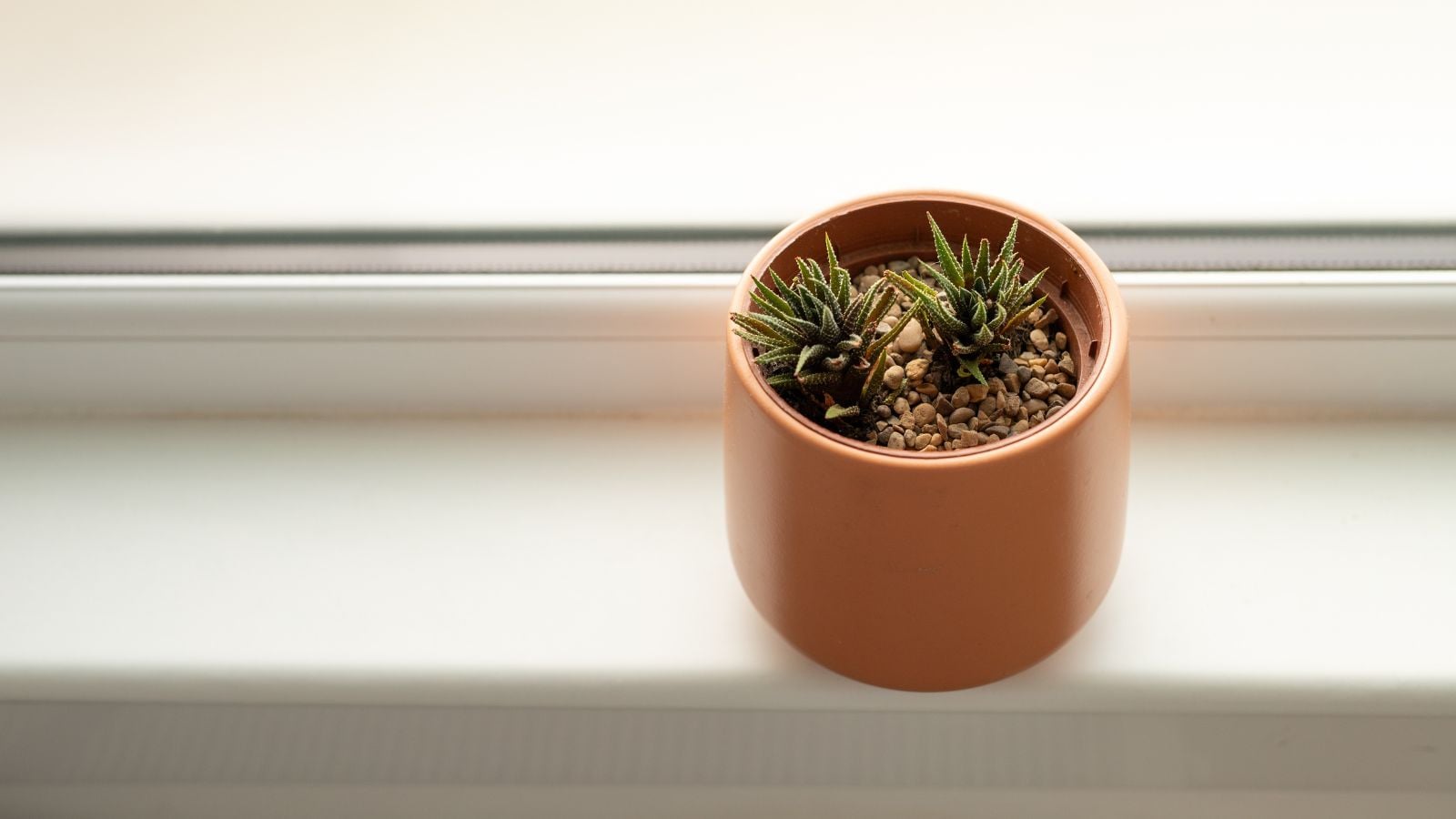
Haworthia varieties take on a different shade with this plant. It features elongated, yellow-green leaves and a tinged red center. The leaf edges are ridged with little teeth, and the tip ends in a small, soft spike. A mature Haworthia chloracantha grows in multiple clumps, making it perfect for xeriscaping.
Haworthia margaritifera
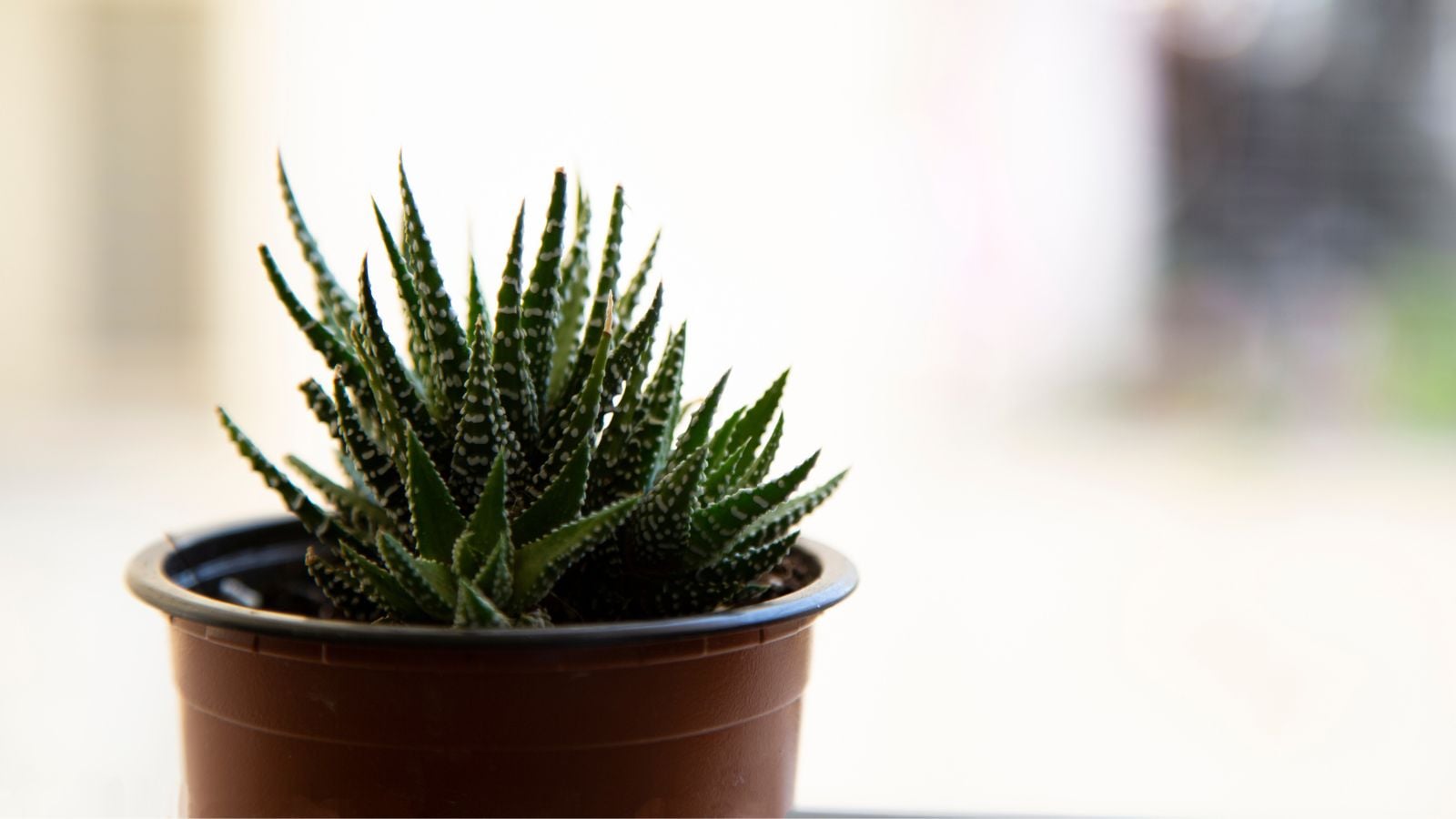
This succulent plant is commonly called pearl plant because of its texture. It has delicate, smooth tubercles that dot the leaves like pearls on silk. Pearl plant is one of the larger haworthias, growing up to six inches across and nearly a foot tall. Its blossoms are also larger than usual, with more of a green or brown color than Haworthia‘s typical white flowers.
Haworthia limifolia

This succulent has rigid leaves that curl on the edges and splay out in a flattened rosette. Their tubercles are usually near the same color as the leaves, giving them a plastic-like look. The inflorescences have multiple white and pink flowers. Haworthia limifolia is often called fairy washboard thanks to its textured leaves.
Haworthia truncata

The common name horse’s teeth sounds strange but makes perfect sense when you take a look at Haworthia truncata. Each leaf is rectangular in shape with slight ridges along the edges. Instead of traditional rosettes, the geometric leaves peek out of the ground in orderly rows. The top of each leaf features a fenestrated skylight and the sides have a rough leaf surface.
Haworthia angustifolia
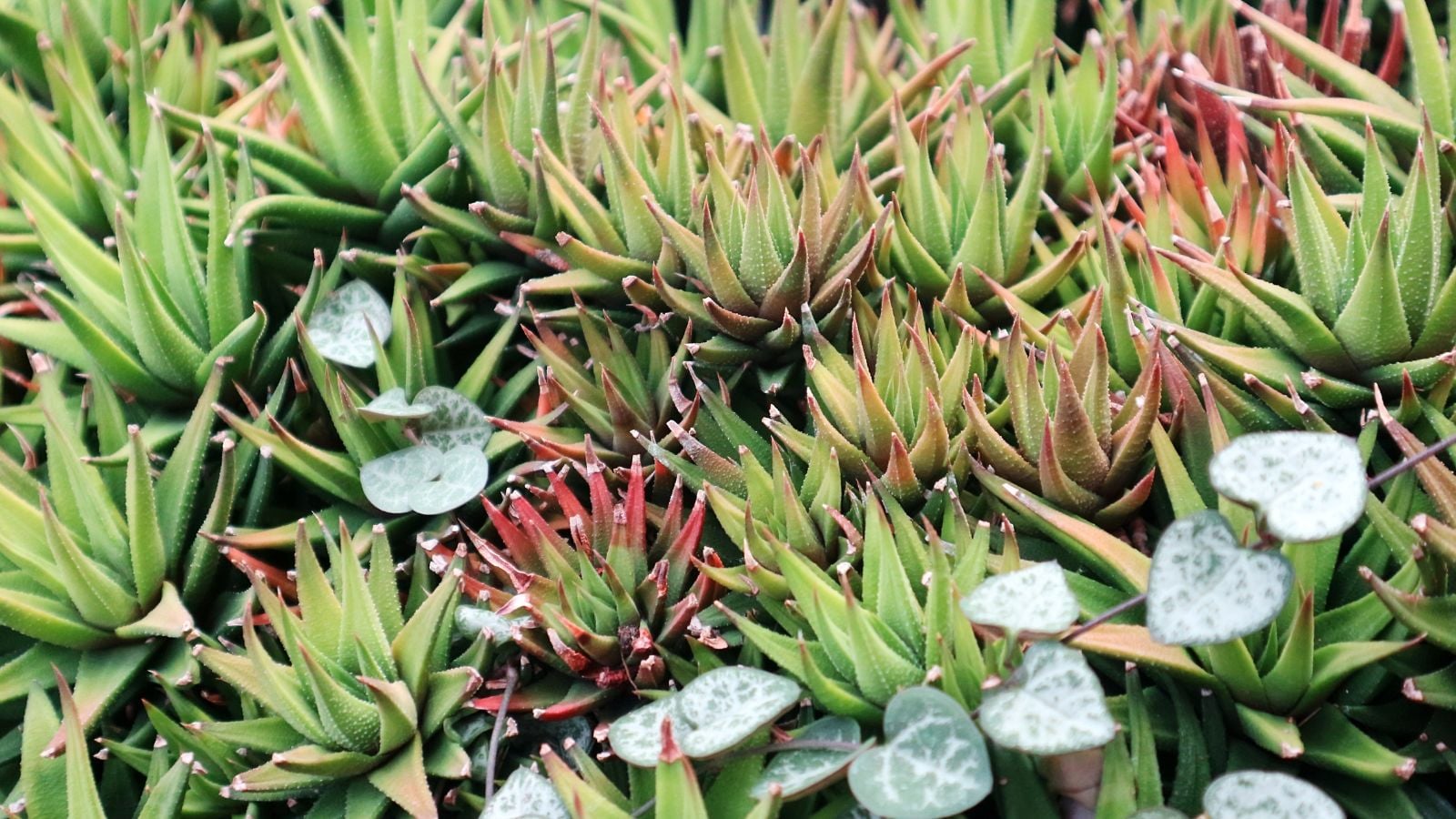
Often called narrow-leaved haworthia, these succulent plants have much thinner leaves than most other common Haworthia varieties. In fact, they look more like a chunky patch of grass than a succulent plant.
The four-inch succulent leaves are still arranged in a rosette, but they’re so long that it’s difficult to tell. Each clump of Haworthia angustifolia has a soft look and feel. It prefers partial shade and will turn brown if left in bright sun.
Haworthia nigra

This dark and brooding succulent will quickly find a place in your heart. Called the black haworthia, Haworthia nigra has very dark green leaves that are rough and warty. The stiff leaves grow folded inside each other, creating a stacked look (they’re more like succulent towers than rosettes). If black haworthia gets stressed due to extreme temperatures in its native South Africa, for instance, it may turn red.
Haworthiopsis attenuata

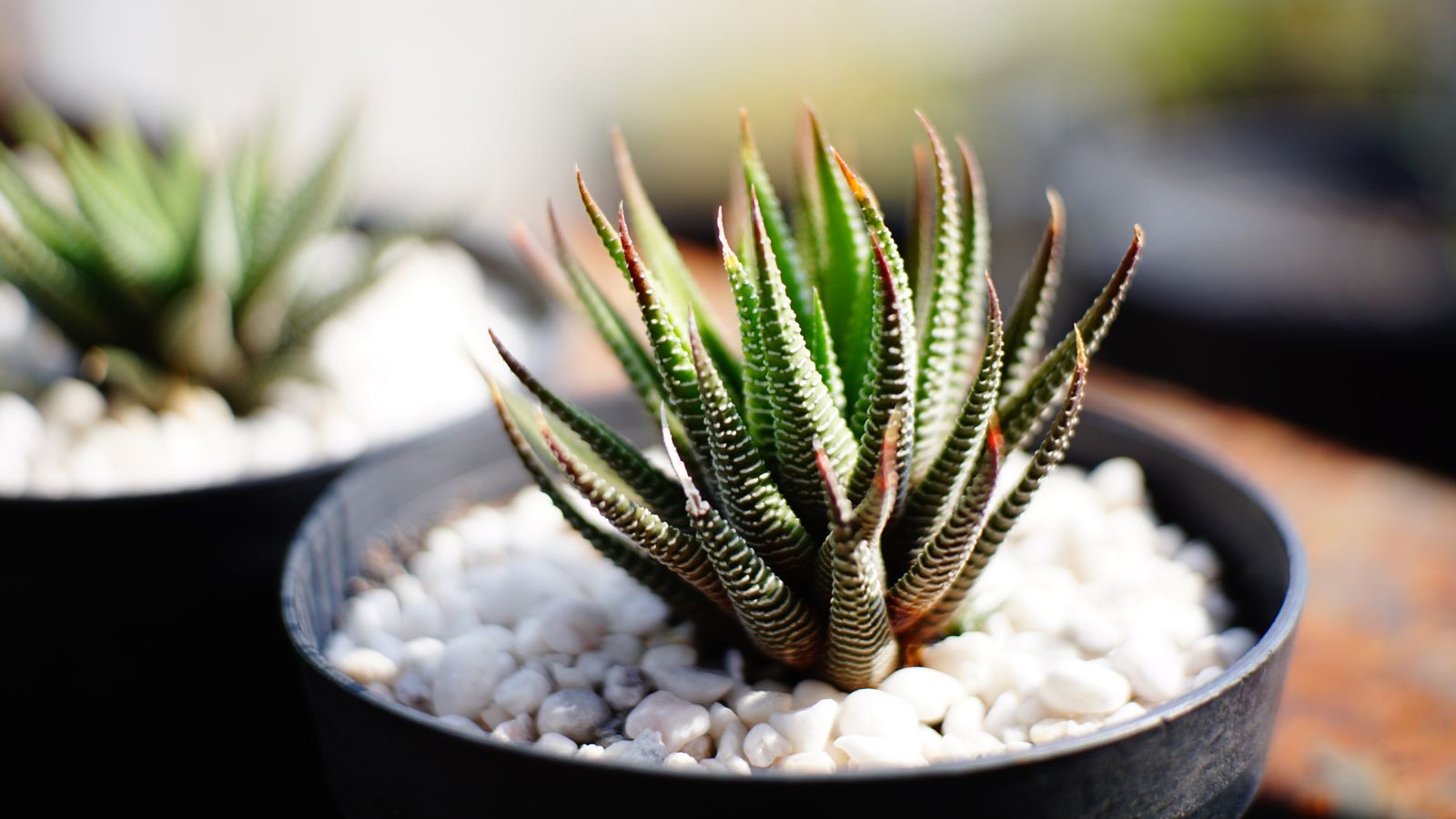
There’s a reason this succulent is nicknamed the zebra plant: it’s covered in white horizontal stripes! The striking marks on this plant, called tubercles, look almost fuzzy since they raise up from the leaf’s surface. There are several different varieties of zebra Haworthia attenuata; some look more striped, while others are dotted with tubercles.
Zebra plants are some of the most common haworthias sold in stores (I even have one at home!). You can easily identify them by the tubercles, which cover the entire leaf surface. When mature, this succulent produces brown and white flowers with curly petals. The blossoms may sit close to the rosette or extend on a spindly stem. It may be slightly confused with little zebra, or Haworthia fasciata.
Haworthiopsis fasciata

If you compare it to zebra plant, you’ll understand why the small succulent plants in the species Haworthia fasciata are called little zebra. The two look very similar but are still separate species. Since they both have white horizontal stripes, the distinguishing factor is stripe placement. While zebra plant is covered head to toe, little zebra (Haworthia fasciata) only has stripes on the undersides of its green leaves.
Little zebra is rare in cultivation and hardly ever sold in garden stores. When it is, it’s often mislabeled. So, if you have a striped succulent, check where the stripes are; it may be rarer than you think!
As we’ve covered in other sections, zebras sometimes get confused with other zebras. In this instance, Haworthia attenuata is sometimes confused for Haworthia reinwardtii, or fasciata.
Haworthiopsis coarctata

This succulent used to be called Haworthia coarctata, as well as many other scientific names. One they can all agree on is the common name crowded haworthia, and it is so crowded. The tubercled leaves are so densely packed together that each rosette forms a pinecone shape.
The leaf colors range from dark green to muddy yellow to light red. Unlike many Haworthia types, Haworthia coarctata has a stem at the core of all those leaves.
Haworthiopsis reinwardtii

These haworthia varieties are similar to Haworthia coarctata but with some obvious differences. Its pinecone shape is less compact and tidy, mostly because the upright-growing, pointed leaves are longer. It also has larger tubercles that resemble those on a zebra plant (no wonder this is called the zebra wart!). Formerly called Haworthia reinwardtii, this succulent is vibrant green with pinkish-white flowers.
Because it resembles the zebra plant, it can sometimes be confused with Haworthia fasciata or Haworthia attenuata.
Haworthiopsis viscosa

Type A gardeners will appreciate how orderly this succulent is. The triangular leaves are neatly stacked into three interlocking rows. Each “tower” grows up to six inches tall and produces an even larger inflorescence. Its coloring is often a gradient of green and red.
Frequently Asked Questions
Are there different types of Haworthia?
Over 60 species! They can be tricky to tell apart, but also include some unique leaf shapes and textures.
How do I identify my Haworthia?
Take a look at its prominent physical characteristics, such as a rough leaf surface or triangular leaves. After matching those to some possibilities, pay attention to smaller details like ridging along the edges. Be careful to keep your Haworthia attenuata apart from other zebras.
Do Haworthias need full sun?
Yes, but some Haworthia succulents need partial shade in high temperatures. Too much bright light can burn the leaf rosettes.
What is the biggest Haworthia?
The largest Haworthias still only reach about 6 inches in diameter. These include H. arachnoidea and H. margaritifera. If you’re looking for height, H. viscosa towers above the other Haworthia types at half a foot tall.
Is Haworthia a cactus or a succulent?
Haworthias are succulent plants that thrive in a cactus soil mix, but are not cacti. Even though they store water, live in hot climates, and are not cold-hardy, they don’t have areoles (a defining characteristic of cacti).
How many types of Haworthias are there?
We know of over 60 species of Haworthia.
What is the difference between Haworthia and Haworthiopsis?
Haworthiopsis contains many species that used to be classified as Haworthias. One of its defining characteristics is a hard, thick epidermis.
What do you do with Haworthia flowers?
You can clip off the stalks when they emerge or after the white flowers have faded. These are slow-growing plants that take a long time to flower, so we encourage enjoying the blossoms! Try a highly diluted cactus fertilizer to spur more blooms.